
How Much Does Dog ICU Cost in Australia? Our Real A$25,000 Vet Bill
An itemised look at mechanical ventilation, intensive care, oxygen support and emergency veterinary treatment after our dog developed severe paralysis tick poisoning.
Published by PawsAround | November 2026 | Health & Safety
When our dog Mr Beans developed paralysis tick poisoning in October 2026, we knew he needed urgent veterinary treatment.
What we didn't expect was how quickly his condition would deteriorate — or how much intensive care would cost.
Within days, Mr Beans went from walking into an emergency veterinary hospital to requiring mechanical ventilation in a specialist intensive care unit.
After treatment at two hospitals, his total veterinary bill reached A$25,291.89.
We're sharing the actual costs from his hospital invoices to help other Australian pet owners understand what a serious veterinary emergency can involve.
These are our real expenses, not estimates or average Australian veterinary prices.
1. Our Total Veterinary Bill: A$25,291.89
Mr Beans received treatment at two veterinary hospitals in New South Wales between 24 and 30 October 2026.
| Veterinary hospital | Total cost |
|---|---|
| ARH Wollongong — Emergency treatment and transfer | A$4,433.70 |
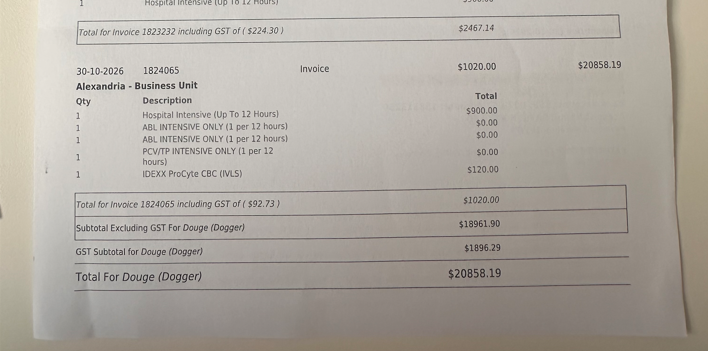
| SASH Alexandria — Specialist hospital and intensive care | A$20,858.19 |
| Combined veterinary expenses | A$25,291.89 |
Approximately 82% of the total bill came from the specialist hospital.
The first hospital provided emergency assessment and treatment, including tick antiserum and supportive care. As Mr Beans' condition worsened, he was transferred to SASH Alexandria for more advanced respiratory and intensive care support.
The costs below focus on the SASH invoices, where we have a detailed breakdown of the major charges.
2. Mechanical Ventilation: A$8,988
One of the largest expenses was mechanical ventilation.
When paralysis tick poisoning becomes severe, the toxin can interfere with the muscles needed for breathing. Some dogs require a ventilator to support their breathing while they receive treatment.
Mr Beans required this level of care.
Our SASH invoices listed:
| Item | Actual charge |
|---|---|
| ECC Campaign Ventilation — per 12 hours | A$2,247 |
| Number of billed 12-hour periods | 4 |
| Total ventilation charges | A$8,988 |
At this rate, two consecutive 12-hour billing periods would cost A$4,494.
This does not mean every dog requiring ventilation will be charged the same amount. Nor does it represent the total daily cost of intensive care.
Additional charges may apply for hospitalisation, medications, diagnostic testing and other treatments.
For Mr Beans, ventilation alone accounted for approximately 43% of the SASH bill.
3. Intensive Hospital Care: A$5,400
Mechanical ventilation was only one part of Mr Beans' hospital treatment.
His invoices also included charges labelled Hospital Intensive (Up To 12 Hours).
| Item | Actual charge |
|---|---|
| Intensive hospital care — up to 12 hours | A$900 |
| Number of billed periods | 6 |
| Total intensive hospital care charges | A$5,400 |
Two full 12-hour billing periods at this rate would amount to A$1,800.
The invoices also listed several intensive monitoring items at A$0, suggesting that certain monitoring services were not charged separately on those occasions.
However, the invoices do not explain exactly which staffing, equipment or monitoring services were included in each intensive care charge.
Together, mechanical ventilation and intensive hospital care cost A$14,388 — approximately 69% of the entire SASH bill.
This illustrates how quickly costs can increase when a pet requires specialist respiratory support and intensive hospital care.
4. Oxygen Support: A$1,812.50
Mr Beans also needed oxygen support during his hospitalisation.
His SASH invoices included several different oxygen-related charges.
| Oxygen-related service | Total |
|---|---|
| Oxygen cage setup | A$130.00 |
| Oxygen cage use (6-hour billing unit) | A$137.50 |
| Nasal oxygen setup (2 charges) | A$520.00 |
| Supplemental oxygen (5 charges) | A$1,025.00 |
| Total oxygen-related charges | A$1,812.50 |
These charges represent the oxygen services recorded on our invoices.
They do not necessarily indicate the exact number of hours Mr Beans received oxygen or the duration of each type of respiratory support.
Oxygen support was an important part of his care as his condition changed during hospitalisation.
5. Diagnostic Tests, Medication and Other Treatment: A$4,657.69
After subtracting the ventilation, intensive hospital care and oxygen-related charges, the remaining SASH expenses totalled A$4,657.69.
This amount includes a range of services and medications recorded in the invoices, such as:
- Emergency diagnostic assessment
- Ultrasound and radiographic examinations
- Blood tests and laboratory investigations
- Intravenous catheter placement and administration
- Antibiotics and other prescribed medications
- Medication for nausea and gastrointestinal symptoms
- Eye medication and supportive treatment
- Specialist consultation
For example, the initial SASH invoice included a comprehensive emergency diagnostic charge of A$1,000 and an IV catheter setup and admission charge of A$250.
Some diagnostic tests were grouped into bundled charges rather than priced individually.
The A$4,657.69 figure is therefore a combined remaining amount, not a single hospital fee or a separately invoiced treatment category.
6. Where Did the SASH A$20,858 Go?
Here is the overall breakdown based on the invoices.
| Expense category | Total | Share of SASH bill |
|---|---|---|
| Mechanical ventilation | A$8,988.00 | 43.1% |
| Intensive hospital care | A$5,400.00 | 25.9% |
| Oxygen-related services | A$1,812.50 | 8.7% |
| Other diagnostics, medication and treatment | A$4,657.69 | 22.3% |
| Total | A$20,858.19 | 100% |
All figures include GST as recorded in the invoices.
The biggest financial impact came from the level of respiratory and intensive care Mr Beans required.
A dog with a less severe illness, a shorter hospital stay or no need for mechanical ventilation could have a very different bill.
Likewise, a longer or more complicated admission could cost substantially more.
7. Why Can Veterinary Intensive Care Be So Expensive?
A specialist veterinary intensive care unit is more than a place for a sick animal to rest.
Depending on the patient's condition, treatment may require specialist equipment, ongoing clinical monitoring, medications, diagnostic tests and highly trained veterinary staff.
Mechanical ventilation is particularly complex because breathing support must be carefully managed and monitored.
For owners, the total cost may involve multiple services billed separately over successive periods.
Our experience shows why looking at one advertised price or one hospitalisation charge may not provide a realistic picture of the total expense.
The final bill depends on the actual care required.
8. Could Pet Insurance Have Helped?
Pet insurance may help with eligible emergency veterinary expenses, but the amount reimbursed depends on the policy.
Consider a hypothetical A$25,000 eligible veterinary bill.
| Reimbursement rate | Potential reimbursement | Owner contribution |
|---|---|---|
| 70% | A$17,500 | A$7,500 |
| 80% | A$20,000 | A$5,000 |
| 90% | A$22,500 | A$2,500 |
These are simplified examples assuming all expenses are eligible, sufficient annual cover remains, and no excess or condition-specific limit applies.
Actual payments may be lower because of exclusions, waiting periods, pre-existing condition rules, excesses or special limits on paralysis tick treatment.
Some Australian pet insurance policies have specific tick paralysis sub-limits, even when their advertised annual benefit limits are much higher.
For a detailed explanation, see our PawsAround guide to Pet Insurance in Australia: Costs, Annual Limits and Paralysis Tick Cover.
9. What Mr Beans' Experience Taught Us
When Mr Beans first arrived at the emergency hospital, he could still walk.
We hoped that finding the tick and getting veterinary help quickly would mean his condition could be managed without major complications.
Unfortunately, he deteriorated and needed specialist respiratory support.
Seeing him in intensive care was one of the most frightening experiences we have had as dog owners.
There were moments when our biggest concern was simply whether he would wake up and breathe independently again.
Thankfully, he survived.
Mr Beans came home on 30 October 2026, still weak and needing time to recover.
Looking back, the financial cost was significant. But what stays with us most is how quickly his condition changed.
We share these figures not to suggest that every tick bite will result in an enormous bill, but to help other pet owners understand the potential consequences of a severe medical emergency.
10. Preparing for Unexpected Veterinary Expenses
No one can predict exactly when a pet might need emergency treatment.
However, there are practical ways to prepare.
Understand your insurance policy. If you have pet insurance, check the annual benefit limit, reimbursement percentage, excess and condition-specific exclusions.
Consider an emergency savings fund. Even insured owners may need to pay a portion of treatment costs or meet expenses before reimbursement.
Know your nearest emergency veterinary hospital. Having contact details available can save valuable time.
Maintain appropriate tick prevention. In paralysis tick regions, use veterinarian-recommended protection and check your dog regularly.
Recognise warning signs early. Weakness, unsteady walking, voice changes, difficulty swallowing and abnormal breathing can indicate a serious problem.
If your dog shows signs of possible paralysis tick poisoning, seek emergency veterinary care immediately.
Frequently Asked Questions
How much does a dog ventilator cost in Australia?
Our SASH Alexandria invoice from October 2026 charged A$2,247 per 12-hour ventilation billing period. Four billed periods totalled A$8,988.
This is one real case, not an Australia-wide standard price. Additional hospitalisation and treatment charges applied.
How much does dog ICU cost per day in Australia?
Our invoices listed intensive hospital care at A$900 for a period of up to 12 hours.
Two such periods would cost A$1,800, excluding ventilation and other services.
Actual ICU costs vary depending on the hospital, medical condition and treatments required.
How much can paralysis tick treatment cost?
Costs vary widely with severity. Mr Beans' severe case required treatment at two hospitals, mechanical ventilation and intensive care, resulting in combined expenses of A$25,291.89.
This should not be interpreted as the typical cost of treating a paralysis tick bite.
Does pet insurance cover dog ICU treatment?
Some accident and illness policies cover eligible intensive care expenses, subject to their terms and conditions.
Check whether paralysis tick poisoning is covered and whether any specific benefit limits apply.
Can a dog recover after needing a ventilator?
Some dogs recover after severe paralysis tick poisoning requiring ventilation, but outcomes depend on their clinical condition and complications.
Mr Beans survived and returned home, although his recovery continued after discharge.
Veterinary teams are best placed to explain an individual dog's prognosis.
---
Final Thoughts
Our dog's A$25,291.89 veterinary bill was something we never expected to face.
Of the A$20,858.19 charged by SASH Alexandria, A$14,388 was attributable to mechanical ventilation and intensive hospital care alone.
Sharing these numbers is not intended to frighten pet owners or discourage necessary veterinary treatment.
It is about providing transparency.
When a pet becomes critically ill, families may need to make difficult decisions under enormous emotional pressure. Understanding the possible financial implications in advance can help with preparation.
Above all, we are grateful that Mr Beans came home.
Every pet's medical journey is different. This was ours.
---
Related Reading on PawsAround
- Mr Beans' Tick Paralysis Story
- What to Do If You Find a Tick on Your Dog in Australia
- Tick Prevention for Dogs in Australia: Don't Rely on Luck
- Pet Insurance in Australia 2026: Comparing Costs, Annual Limits and Paralysis Tick Cover
About the Figures
The financial figures in this article come from our family's veterinary invoices issued by ARH Wollongong and SASH Alexandria in October 2026.
The detailed cost breakdown is based on the SASH invoices, including GST. Charges have been grouped for readability. The article is an independent personal account and is not sponsored or endorsed by either hospital.
Disclaimer: This article shares one family's veterinary experience and provides general information only. It is not a veterinary diagnosis, treatment recommendation, financial advice or estimate of future veterinary costs. For medical emergencies, seek professional veterinary care immediately.