
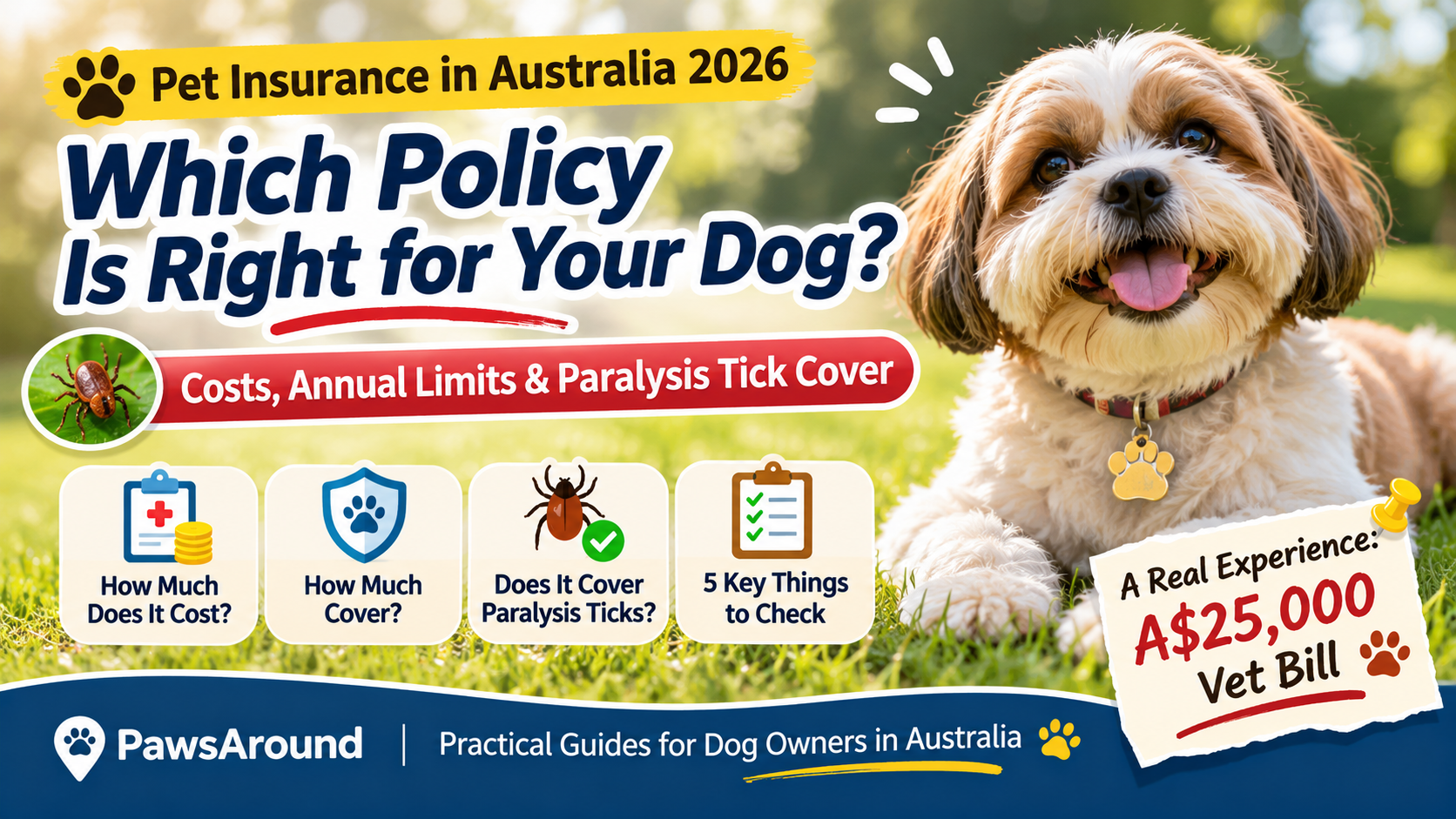
Pet Insurance in Australia 2026: Comparing Costs, Annual Limits and Paralysis Tick Cover
Meta description: Compare six Australian pet insurance providers in 2026, including premiums, annual benefit limits and paralysis tick cover. Learn what to check before choosing a policy.
Updated: November 2026 | Reading time: approximately 7 minutes
When a Tiny Tick Leads to a $25,000 Vet Bill
How much would you be prepared to spend to save your dog's life?
For our family, this became a very real question when Mr Beans, our beloved dog, developed severe paralysis tick poisoning in October 2026.
What began with weakness in his back legs progressed into a medical emergency. He required treatment at two veterinary hospitals, intensive care and mechanical ventilation.
Mr Beans eventually came home, but his treatment cost more than A$25,000.
His experience prompted an important question: could pet insurance help Australian dog owners manage an emergency of this scale?
The answer depends on much more than the advertised annual benefit limit.
In this guide, we compare six Australian pet insurance providers, explain how much cover may cost and examine a particularly important consideration for dogs living along Australia's east coast: paralysis tick treatment.
1. How Much Does Pet Insurance Cost in Australia?
According to Canstar's 2026 research, average annual premiums for dog accident and illness insurance were:
| Dog size | Average annual premium | Approximate monthly cost |
|---|---|---|
| Small dogs | A$1,1580 | A$132 |
| Medium dogs | A$1,693 | A$141 |
| Large dogs | A$1,834 | A$153 |
| All dogs | A$1,718 | A$143 |
These figures are market averages, not quotations from individual insurers.
Your actual premium can vary significantly depending on your dog's breed, age, location, medical history and chosen policy.
The annual benefit limit, reimbursement percentage and excess can also affect the price.
For a meaningful comparison, request quotations using the same dog details and similar coverage settings.
2. Comparing Six Australian Pet Insurance Providers
The following table compares selected accident and illness products available in Australia.
| Provider | Selected policy | Annual benefit limit | Paralysis tick cover |
|---|---|---|---|
| Fetch | Pet Insurance | Up to A$40,000 | Subject to policy conditions |
| RSPCA | PetFlex | Up to A$35,000 | Eligible illness cover; no condition sub-limits |
| Bow Wow Meow | Nose-to-Tail | Up to A$30,000 | Covered; no condition sub-limit |
| Medibank | Pet Plus | Up to A$25,000 | Covered; no tick paralysis sub-limit |
| Knose | Pet Insurance | Up to A$25,000 | Tick paralysis example provided; no condition sub-limits |
| Budget Direct | Plus | Up to A$25,000 | Covered, but A$3,000 tick paralysis sub-limit |
These are selected product configurations, not necessarily each provider's cheapest plan. All amounts are in Australian dollars. Coverage remains subject to the applicable Product Disclosure Statement (PDS), eligibility, exclusions, waiting periods, reimbursement percentage and excess.
Fetch
Fetch advertises a 12-month treatment limit of A$40,000, with reimbursement options that can reach 100%, depending on the plan.
However, a high reimbursement percentage does not guarantee that every veterinary expense will qualify.
Pet owners should check the policy's specific paralysis tick provisions, parasite prevention requirements and exclusions before purchasing cover.
RSPCA PetFlex
RSPCA PetFlex offers customisable cover with an annual limit of up to A$35,000.
One notable feature is the absence of condition-specific sub-limits in its current PetFlex product.
This can be particularly relevant when a single illness requires expensive hospital treatment.
Older RSPCA policies may have different limits, so existing customers should check their actual policy documents.
Bow Wow Meow Nose-to-Tail
Bow Wow Meow offers annual benefit limit options of A$10,000, A$20,000 and A$30,000, with reimbursement options of 70%, 80% or 90%.
Its Nose-to-Tail product explicitly includes tick paralysis and does not impose a separate tick paralysis sub-limit.
The overall annual limit and other policy conditions still apply.
Medibank Pet Plus
Medibank Pet Plus offers up to A$25,000 annually and reimbursement of up to 80% of eligible veterinary expenses.
Importantly, this product does not have a separate tick paralysis sub-limit.
However, Medibank's lower-tier Pet Protect product has a A$4,000 tick paralysis sub-limit.
This demonstrates why comparing insurance brands alone is not enough: the particular policy tier matters.
Knose
Knose offers policies with annual limits of up to A$25,000 and promotes cover without condition-specific sub-limits.
Its published materials include a tick paralysis claim example.
Owners should still check the current PDS for treatment eligibility, waiting periods and exclusions.
Budget Direct
Budget Direct offers several policy levels, including Essential, Comprehensive and Plus.
All three list tick paralysis cover, but their specific annual tick paralysis limits differ:
- Essential: A$1,000
- Comprehensive: A$1,500
- Plus: A$3,000
Even with the Plus policy's A$25,000 overall annual limit, the A$3,000 tick paralysis sub-limit can substantially restrict reimbursement for a major tick-related emergency.
This is one of the most important distinctions in the comparison.
3. Does Pet Insurance Cover Paralysis Tick Poisoning?
Many Australian accident and illness policies include treatment for paralysis tick poisoning.
Depending on the policy, eligible treatment may include veterinary consultations, hospitalisation, diagnostic tests, prescribed medication, intensive care and specialist treatment.
However, coverage is not automatic.
Insurers may apply:
- Waiting periods before illness cover begins
- Exclusions for pre-existing conditions
- Parasite prevention requirements
- Treatment-specific or condition-specific limits
- Annual benefit limits
- Reimbursement percentages and excesses
Routine preventative products, such as tick prevention chews or spot-on treatments, are generally not included in standard illness cover. Some insurers offer separate routine-care benefits.
Important: A dog showing signs of paralysis tick poisoning needs urgent veterinary assessment. Insurance questions should never delay emergency treatment.
4. What Could Insurance Pay Towards a A$25,000 Vet Bill?
Consider a hypothetical emergency with A$25,000 in veterinary expenses.
If all expenses are eligible, no excess applies, the policy has sufficient remaining annual cover and there are no relevant sub-limits:
| Reimbursement rate | Hypothetical insurer payment | Owner pays |
|---|---|---|
| 70% | A$17,500 | A$7,500 |
| 80% | A$20,000 | A$5,000 |
| 90% | A$22,500 | A$2,500 |
These figures are illustrations, not estimates of what any particular insurer would pay.
Now consider a policy with a A$3,000 paralysis tick sub-limit.
Even if its overall annual benefit limit is A$25,000, its payout for that condition may be capped at A$3,000, subject to the policy's calculation rules.
This is why the annual benefit limit should never be considered in isolation.
5. Five Things to Check Before Buying Pet Insurance
Annual benefit limit
This is the maximum amount the insurer may pay during the policy period.
For owners concerned about major emergencies, consider whether the limit could accommodate intensive care or specialist treatment.
Reimbursement percentage
A policy may reimburse 70%, 80%, 90% or another percentage of eligible expenses.
The remaining portion is generally your responsibility.
Excess
An excess is an amount you contribute towards a claim. Depending on the policy, it may apply per condition, per claim or per policy period.
Condition-specific sub-limits
Look for separate limits on paralysis tick treatment, cruciate ligament surgery, dental treatment and other potentially expensive conditions.
A high annual benefit limit can be much less useful when the particular condition has a low sub-limit.
Waiting periods and pre-existing conditions
A policy purchased after symptoms have appeared generally cannot be relied upon to cover that existing illness.
If your dog has previously experienced paralysis tick poisoning, ask the insurer how that history would affect future claims and request clarification in writing.
6. Is Pet Insurance Worth It?
There is no universal answer.
Some dog owners prefer insurance because they want financial support if their pet requires major emergency treatment.
Others prefer to build a dedicated emergency savings fund, particularly when premiums become expensive as their pet ages.
Both approaches involve trade-offs.
Insurance may reduce the financial impact of an eligible major claim, but premiums are an ongoing cost and policies contain restrictions.
An emergency fund offers flexibility, but it may not be sufficient for a sudden five-figure veterinary bill.
When deciding, consider your dog's health, your household budget, your capacity to meet unexpected expenses and the treatment decisions you would want to make in an emergency.
7. What Mr Beans Taught Us
Before Mr Beans became critically ill, it was difficult to imagine how quickly a small parasite could lead to intensive care and substantial veterinary expenses.
His recovery has made us more aware of the importance of prevention, early recognition of symptoms and financial preparation.
For Australian dog owners, particularly those living in paralysis tick regions, insurance comparisons should go beyond the headline annual benefit limit.
Check what is covered, what is excluded and how much the insurer could actually pay for the emergency you are most concerned about.
No policy can prevent a medical emergency, but understanding your options beforehand may make an already stressful situation easier to manage.
---
Frequently Asked Questions
Does pet insurance cover paralysis ticks in Australia?
Many accident and illness policies include eligible paralysis tick treatment. However, cover varies between insurers and product tiers, and some policies impose specific tick paralysis sub-limits.
Does pet insurance pay for tick prevention products?
Usually not under standard accident and illness cover. Some optional routine-care benefits may contribute towards eligible preventative treatments.
Can I buy insurance after my dog has been diagnosed with tick paralysis?
You can enquire about future cover, but an existing diagnosis or symptoms will generally be considered under pre-existing condition rules. A new policy should not be expected to pay for an illness that has already occurred.
Is a A$30,000 annual benefit limit enough?
It depends on the treatment required, reimbursement rate, excess, exclusions and any condition-specific limits. A high annual limit alone does not guarantee a large payout.
Which pet insurance is best for paralysis tick cover?
There is no single best policy for every dog. Compare current PDS documents, particularly tick paralysis sub-limits, parasite prevention requirements, annual limits, reimbursement percentages and exclusions.
---
Sources and Further Reading
- Canstar — Pet Insurance Costs in Australia (opens in a new tab)
- Canstar — 2026 Pet Insurance Awards (opens in a new tab)
- Fetch — Product Disclosure Information (opens in a new tab)
- RSPCA — PetFlex Comparison (opens in a new tab)
- Bow Wow Meow — Cover Options (opens in a new tab)
- Medibank — Pet Insurance (opens in a new tab)
- Knose — Dog Insurance (opens in a new tab)
- Budget Direct — Policy Comparison (opens in a new tab)
Disclaimer: This article provides general information only and does not constitute personal financial advice or an insurance recommendation. PawsAround is not an insurance provider. Policy features, premiums, limits and exclusions can change. Always read the current Product Disclosure Statement (PDS) and Target Market Determination (TMD) and obtain an individual quote before making a decision. No insurer listed has been represented as endorsing this article.